
 Overview
English
Please find below our English curriculum, based on the Bishop Wilkinson’s Catholic Education Trust’s curriculum offer. The impressive literacy canon is matched by a focus on the four pillars of the ‘literate child’.
a) Oracy b) Reading c) English Grammar, Punctuation and Spelling and d) Writing
English Medium-Term Plan
Year 1
View the subject overview.
Year 2
View the subject overview.
Year 3
View the subject overview.
Year 4
View the subject overview.
Year 5
View the subject overview.
Year 6
View the subject overview.
St. Alban’s recognise that:
- Regular teaching of EGPS, which forms part of the unit of study – this should take place on a weekly basis
- Daily revision of key skills e.g. abstract nouns, subjunctive mood, tense work via memory recall at the start of the lesson (‘Take 3 approach’)
- Or if the EGPS components are pivotal to the writing journey, successive EGPS lessons may take place over two or three days to support pupils’ ability to utilise EGPS structures, within extended writing tasks.
Please find below a summary of the Nelson Handwriting Scheme for Handwriting
What your child will learn
In Year 1 (age 5–6), your child will learn to:
- Sit correctly at a table, holding a pencil comfortably and correctly.
- Form lowercase letters in the correct direction, starting and finishing in the right place.
- Form capital letters.
- Form digits 0–9.
- Understand which letters belong to which handwriting ‘families’ (letters that are formed in similar ways).
- Leave spaces between words.
In Year 2 (age 6–7), your child will learn to:
- Form lowercase letters of the correct size relative to one another.
- Start using some of the diagonal and horizontal strokes needed to join.
- Letters and understand which letters, when adjacent to one another, are best left unjoined.
- Write capital letters and digits of the correct size, orientation and relationship to one another and to lowercase letters.
- Understand which letters belong to which handwriting ‘families’ (i.e. letters that are formed in similar ways).
- Use spacing between words that reflects the size of the letters.
In Year 3 (age 7–8), your child will learn to:
- Use the diagonal and horizontal strokes that are needed to join letters and understand which letters, when adjacent to one another, are best left unjoined.
- Increase the legibility, consistency and quality of their handwriting (for example, by ensuring that the downstrokes of letters are parallel and equidistant; that lines of writing are spaced sufficiently so that the ascenders and descenders of letters do not touch).
In Year 4 (age 8–9), your child will continue learning to:
- Use the diagonal and horizontal strokes that are needed to join letters and understand which letters, when adjacent to one another, are best left unjoined.
- Increase the legibility, consistency and quality of their handwriting (for example, by ensuring that the downstrokes of letters are parallel and equidistant; that lines of writing are spaced sufficiently so that the ascenders and descenders of letters do not touch).
In Year 5 (age 9–10), your child will learn to:
- Choosing which shape of a letter to use when given choices and deciding whether or not to join specific letters
- Choosing the writing implement that is best suited for a task.
In Year 6 (age 10–11), your child will learn to:
- Choose which shape of a letter to use when given choices and deciding whether or not to join specific letters
- Choose the writing implement that is best suited for a task.

We follow Read Write Inc to teach children to read in Early Years and Key Stage 1.
Here are some helpful links for parents/ carers to watch and use to help encourage reading at home.
| Page Views | 626
Updated | 17th March, 2026 |
Latest News
Celtic knotwork
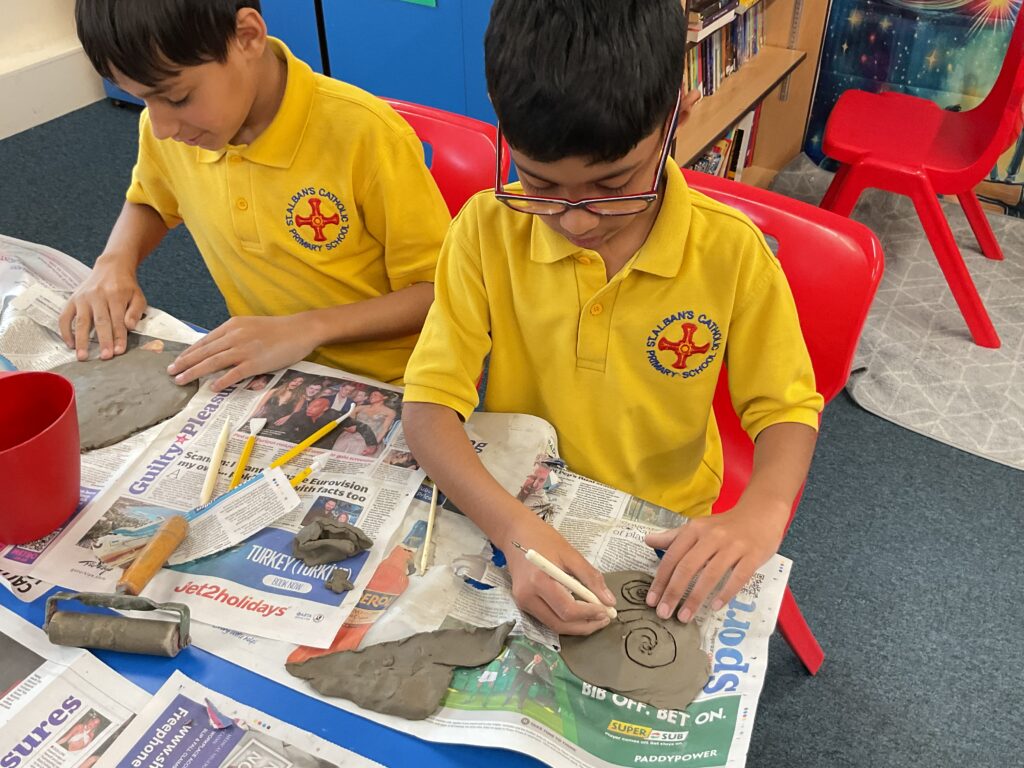
This half term, Year 5 have been looking at the Lindisfarne Gospels and Celtic knotwork. Children designed their own St Cuthbert’s cross and included a range of clay textures and patterns. Children then evaluated their design to see if it met their original brief.
Published: May 19, 2026


The Bishop Wilkinson Catholic Education Trust is an exempt charity. It is a company limited by guarantee registered in England and Wales under company registration number 07890590. The registered office address is Bishop Wilkinson Catholic Education HQ, Barmston Court, Turbine Business Park, Nissan Way, Washington, SR5 3NY.